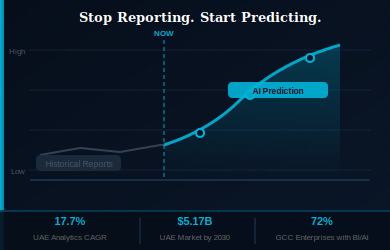
The UAE data analytics market hit USD 1.88 billion in 2024 and is projected to reach USD 5.17 billion by 2030. Predictive analytics is already its largest segment. The businesses winning in the GCC are not just reporting what happened last quarter - they are predicting what will happen next, and acting before their competitors do.
Most businesses in the UAE and GCC are sitting on a goldmine they cannot access. Their ERP holds years of sales history. Their CRM contains thousands of customer interactions. Their finance system tracks every transaction. Their operations data records every delay, every stockout, every inefficiency.
And yet most of this data is used for one thing: reporting what already happened.
A monthly sales report. A quarterly inventory count. An annual P&L review. Useful — but fundamentally backward-looking. By the time the report is on the desk, the opportunity it describes has passed or the problem it reveals has already cost money.
The shift that is defining competitive advantage across the GCC right now is the move from descriptive intelligence — what happened — to predictive and prescriptive intelligence — what will happen, and what should we do about it. And it is happening faster than most businesses realise.
The Numbers: Why Predictive Analytics Is the GCC's Fastest-Growing Technology Priority
$1.88B
UAE Data Analytics Market 2024
17.7%
UAE Analytics CAGR 2025–2030
72%
Large GCC Enterprises with BI or AI Platform by 2025
69%
of GCC Organisations Planning to Increase AI Investment
38.7%
UAE Analytics Revenue: Predictive Segment Share
21.7%
Global Predictive Analytics CAGR to 2031
$22.4B
GCC AI Market by 2033 (15.2% CAGR)
50%
of GCC Organisations Lack Capability to Scale AI
Sources: Grand View Research 2026, IMARC Group 2025, Deloitte & MBZUAI 2025, GulfLeads 2026
The data is unambiguous. Predictive analytics is the largest revenue-generating segment of the UAE's data analytics market, holding a 38.7% revenue share in 2024. The overall UAE data analytics market is growing at 17.7% annually - nearly three times the global average. And by 2025, an estimated 72% of large GCC enterprises had already implemented at least one BI or AI analytics platform, with the region's BI maturity now on par with Western Europe.
Yet the same Deloitte and MBZUAI research that documents this investment surge also reveals the critical gap: almost half of GCC organisations said they lacked the talent and technology capabilities needed for successful AI scaling. Investment is rising. Execution capability needs to catch up.
Descriptive vs Predictive vs Prescriptive: Understanding the Three Levels of Analytics
Before exploring how predictive analytics works in practice, it is important to understand the three levels of analytical maturity — because most businesses in the UAE and GCC are stuck at the first level, even when they believe they are doing analytics.
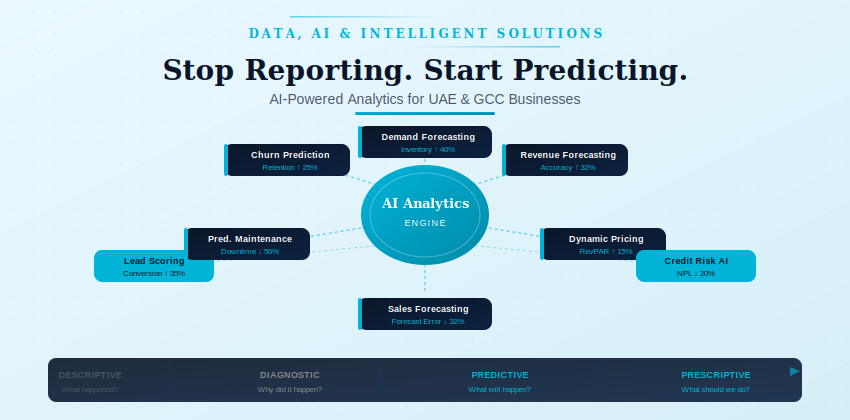
DESCRIPTIVE
What happened?
Sales reports, dashboards, KPI summaries, inventory counts. Useful for understanding history but cannot inform action before cost is incurred. Most UAE businesses operate here. Power BI dashboards and Excel reports fall into this category.
PREDICTIVE
What will happen?
Machine learning models trained on historical data to forecast future outcomes — demand, churn, revenue, risk. The model learns patterns humans cannot see in large datasets and generates probability-based predictions with defined confidence levels.
PRESCRIPTIVE
What should we do?
The most advanced tier. AI not only predicts the outcome but recommends the optimal action — dynamically adjusting pricing, automatically reordering stock, routing a customer to the right service path, or allocating resources before a bottleneck forms.
The goal for GCC businesses is to move progressively up this maturity curve — starting with clean, connected data, building reliable predictive models for the highest-value business decisions, and ultimately reaching prescriptive intelligence where the system takes action automatically within defined parameters.
Seven High-Value Predictive Analytics Use Cases for UAE and GCC Businesses
The most effective approach to predictive analytics is identifying the decisions your business already makes repeatedly that currently rely on gut feel, historical averages, or manual analysis — and replacing that uncertainty with a data-driven prediction. Here are the seven use cases delivering the strongest ROI for businesses across the UAE and GCC:
How GCC Market Leaders Are Already Using Predictive Analytics
The shift from descriptive to predictive intelligence is not theoretical for the GCC's leading businesses. It is already operational:
Emirates NBD — Banking: The bank evolved from a central data warehouse into a distributed data mesh architecture where each business unit owns its data but follows unified governance. By 2025, Emirates NBD had over 100 production machine learning models active, with deployment pipeline time reduced from 12 weeks to under 5 days. The bank now generates 360-degree predictive customer insight models across its entire retail and corporate portfolio.
Majid Al Futtaim — Retail: One of the UAE's largest retail conglomerates built dedicated data teams to forecast demand, personalise marketing campaigns, and optimise store layouts and assortment across its Carrefour, Mall of the Emirates, and entertainment properties — using predictive models to drive measurable improvements in conversion and margin.
Emirates, Etihad, and Qatar Airways — Aviation: All three carriers integrate live passenger analytics into every operational function — from revenue management and route planning to baggage handling and crew scheduling. Predictive models drive real-time decisions across the full passenger journey.
These are enterprise examples. But the same analytical capabilities are now accessible to mid-market businesses in the UAE through cloud AI platforms — at a fraction of the infrastructure cost that these organisations invested five years ago.
The Data Foundation: What Your Business Needs Before Predictive Analytics
Predictive analytics is only as good as the data that feeds it. The most common reason businesses in the UAE fail to extract value from analytics investments is not the algorithm — it is the data architecture underneath it. Before implementing predictive models, businesses need to address four foundational requirements:
Data Connectivity
Data from ERP, CRM, finance, operations, and customer platforms must be connected in a unified data layer — not siloed in separate systems. A predictive model that can only see one system's data will always miss the patterns that span them. Data pipelines and integration architecture are the critical first step.
Data Quality
Incomplete records, duplicate entries, inconsistent formats, and missing historical data all degrade model accuracy. A data quality assessment and remediation programme is typically required before meaningful predictive models can be trained. Garbage in, garbage out applies more strictly to ML models than to any other technology.
Historical Depth
Most predictive models require a minimum of 18–24 months of quality historical data to identify reliable patterns — particularly for seasonal and cyclical predictions. For businesses that have not systematically stored and structured historical data, establishing this foundation is the first priority. Cloud data warehouses (Azure Synapse, AWS Redshift, Google BigQuery) make this more accessible than ever.
Business Alignment
A predictive model that cannot be acted upon by the business is just an expensive report. From the outset, each analytics initiative must be anchored to a specific business decision, a named decision-maker, and a clear action that will follow from the prediction. Start with boring use cases — churn, stock, leads — that have clear data, clear business value, and clear action.
Predictive Analytics Across GCC Industries
While predictive analytics adds value across virtually every sector, the following industries in the UAE and GCC are seeing the strongest implementation momentum:
- Retail & E-Commerce: Demand forecasting, personalisation engines, basket size prediction, promotion effectiveness modelling, and customer lifetime value prediction. UAE retail is a AED 120+ billion market where margin and inventory efficiency are key competitive differentiators.
- Financial Services & Insurance: Credit risk scoring, fraud detection, claims prediction, customer lifetime value, cross-sell propensity, and regulatory stress testing. UAE banks and insurance companies are among the most advanced predictive analytics adopters in the region.
- Real Estate & Property Management: Price prediction models, tenant churn forecasting, maintenance cost prediction, and portfolio performance analytics. With Dubai's property market at record transaction volumes, data-driven pricing and risk modelling are increasingly standard for serious developers and investors.
- Healthcare: Patient no-show prediction, readmission risk scoring, resource allocation forecasting, and supply chain optimisation for medical consumables. Private healthcare groups across Dubai and Abu Dhabi are implementing predictive models to improve operational efficiency and patient outcomes simultaneously.
- Logistics & Supply Chain: Route optimisation, delivery delay prediction, customs clearance time forecasting, and warehouse capacity planning. The UAE's position as a global logistics hub makes supply chain prediction a high-priority investment.
- Hospitality & Tourism: Revenue per available room (RevPAR) optimisation, occupancy forecasting, guest spend prediction, and staff scheduling based on predicted demand. Dubai's hospitality sector — over 120,000 hotel rooms and growing — uses sophisticated revenue management models as a standard operating practice.
How Innate Technologies Delivers Predictive Analytics for UAE and GCC Businesses
At Innate Technologies, our Data, AI & Intelligent Solutions practice is built around a straightforward principle: data should drive decisions, not just describe history. We help businesses across the UAE and GCC move from reporting to prediction — building AI analytics capabilities that are practical, scalable, and anchored to measurable business outcomes.
Our end-to-end analytics delivery covers:
- Data Strategy & Architecture: Assessing your current data landscape, designing connected data pipelines, and building the unified data foundation that predictive analytics requires. We work across cloud platforms including Azure, AWS, and Google Cloud.
- Business Intelligence & Dashboard Development: Building executive and operational dashboards in Power BI, Tableau, or Looker that replace static reports with real-time, interactive intelligence — the descriptive layer that feeds into predictive models.
- Custom Predictive Model Development: Building machine learning models tailored to your specific business questions — demand forecasting, churn prediction, lead scoring, revenue forecasting, risk modelling — trained on your data and validated against your business context.
- AI Integration into Existing Systems: Embedding predictive outputs directly into your ERP, CRM, or operational platforms — so predictions are acted on within existing workflows, not in a separate analytics silo that nobody checks.
- Model Monitoring & Continuous Improvement: Predictive models degrade over time as business conditions change. We implement model monitoring, drift detection, and regular retraining cycles to ensure ongoing accuracy and relevance.
- Team Training & Analytics Culture: We work with your leadership and operational teams to build the data literacy and decision-making frameworks needed to act on predictions — because a model nobody trusts or uses has zero business value.
Where to Start: The Right First Predictive Analytics Project
The best first predictive analytics project for most businesses is one that is boring on paper - and that is genuinely a recommendation. A boring use case typically has clear historical data, a specific decision it informs, and a measurable business outcome when the prediction is acted upon.
Start here:
- Churn prediction if your business has a recurring revenue model with identifiable attrition patterns
- Demand forecasting if inventory management is a significant operational cost or customer service risk
- Lead scoring if your sales team is managing a high volume of inbound leads with inconsistent follow-up quality
- Payment delay prediction if accounts receivable management is a cash flow priority
- Revenue forecasting if your sales pipeline management and financial planning are currently driven by manual estimates
The worst first predictive analytics project is the most ambitious one — a platform-wide AI transformation with multiple models, new infrastructure, and cross-departmental change simultaneously. Start focused, prove value, and expand from a foundation of demonstrated results.
Conclusion: The Competitive Gap Is Already Opening
The GCC's leading businesses are already operating on predictive intelligence. Emirates NBD has 100+ production ML models. GCC retailers forecast demand at SKU level weeks in advance. UAE banks score credit risk dynamically in real time. Hospitality groups price rooms algorithmically across every distribution channel.
For mid-market businesses in the UAE and GCC, the gap between organisations that have made this shift and those that have not is widening every year. The good news is that the infrastructure cost of predictive analytics has fallen dramatically — cloud platforms, pre-built ML frameworks, and experienced implementation partners mean that capabilities available only to enterprise organisations five years ago are now achievable for businesses of any size.
The question is not whether predictive analytics is relevant to your business. Every business that makes repeated decisions under uncertainty - about stock, about customers, about revenue, about risk - benefits from prediction over guesswork. The question is when you will start, and whether you will start before your competitors do.
Start Your Predictive Analytics Journey with Innate Technologies
Innate Technologies helps businesses across Dubai, UAE, and the GCC move from historical reporting to AI-powered predictive intelligence — from data strategy and BI dashboards to custom machine learning models and system integration. Whether you are starting your analytics journey or looking to move from descriptive to predictive, our team is ready to help. Get in touch to schedule a free discovery conversation.
Tags: predictive analytics UAE, AI analytics Dubai, business intelligence UAE, predictive analytics GCC, data analytics Dubai, machine learning UAE, demand forecasting UAE, customer churn prediction UAE, AI for business UAE, data science UAE, Power BI Dubai, revenue forecasting GCC, AI data analytics Dubai, predictive modelling UAE, analytics consulting Dubai