With the GCC CRM market growing at 8.5% annually and a CRM proven to boost revenue by up to 29%, the question for UAE and GCC businesses is no longer whether to invest in a CRM — it is whether the one you have is actually working for you.
The CRM Opportunity in UAE and GCC: A Market Moving Fast
Walk into almost any business meeting in Dubai, Riyadh, or Doha and you will hear the same thing: the team is busy, leads are slipping through the cracks, sales forecasts are inaccurate, and no one has a clear picture of what the pipeline actually looks like. These are not problems unique to one industry or one company. They are symptoms of a CRM gap — and they are costing businesses across the GCC real money, every day.
Customer Relationship Management software has become one of the fastest-growing enterprise technology categories in the region. The GCC CRM market is projected to grow at a compound annual rate of 8.5% through 2034, with the Middle East and Africa CRM market valued at USD 4.63 billion in 2025 and forecast to reach USD 17.32 billion by 2035. Saudi Arabia alone allocated over USD 10 billion to its ICT sector in 2024 — a direct driver of accelerating CRM adoption across the Kingdom’s Vision 2030 transformation agenda.
In the UAE, the picture is equally compelling. Dubai and Abu Dhabi dominate as commercial hubs where CRM adoption is being driven by the retail, financial services, real estate, healthcare, and hospitality sectors — all industries where customer relationships are the primary competitive differentiator. Major CRM vendors including Salesforce, Zoho, and Microsoft have all made significant regional commitments: Salesforce announced a USD 500 million investment in Saudi Arabia in January 2025, while Zoho launched its first Middle East data centres in Riyadh and Jeddah to address data residency requirements.
8.5%
GCC CRM Market CAGR to 2034
$17.3B
MEA CRM Market by 2035
29%
Revenue Boost from Effective CRM
40%
Productivity Increase with CRM
32%
Better Sales Forecast Accuracy with CRM
83%
of Senior Execs Report CRM Resistance
47%
Sales Leaders: CRM Won’t Meet Goals
76%
Sales Teams Don’t Use All CRM Features
Here is the paradox at the heart of CRM in the GCC: every metric shows that a well-implemented CRM dramatically improves business performance. Yet nearly half of sales leaders globally do not believe their CRM will help them meet their goals over the next three years. And 76% of sales teams are not using all the tools their CRM provides. The problem is almost never the software. It is almost always the implementation, the configuration, and the adoption strategy behind it.
Seven Warning Signs Your CRM Is Not Working for Your Business
Many businesses in the UAE and GCC have a CRM. Far fewer have a CRM that is genuinely driving their sales performance. Here are the warning signs that your current system is costing you more than it is contributing:
What a Properly Implemented CRM Actually Delivers
A CRM that is configured correctly – around your actual sales process, your team structure, your customer journey, and your reporting requirements – is not a contact database. It is the operational backbone of your sales, marketing, and customer service functions. Here is what it should be doing:
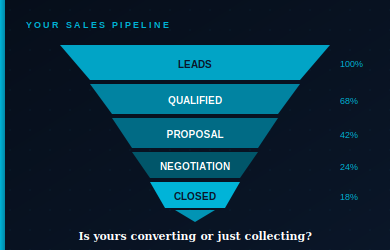
Complete Pipeline Visibility
Every deal, at every stage, with probability weighting, expected close date, and next action — visible to sales managers in real time without asking a single team member for an update.
Automated Lead Management
Every inbound lead is automatically assigned, acknowledged, and tracked. Overdue follow-ups are escalated. No lead falls through without a logged touchpoint.
Customer 360 View
Every interaction, every transaction, every support ticket — visible in a single customer record, connected across sales, finance, and service. No more asking colleagues what happened with a client.
AI-Powered Sales Forecasting
With the right data in the CRM, AI-assisted forecasting provides accurate revenue projections, identifies deals at risk, and surfaces the highest-probability opportunities for the team to prioritise.
Marketing Attribution
Clear line of sight from lead source through pipeline to closed revenue — enabling your team to know which marketing channels, campaigns, and events are actually generating business, not just generating traffic.
Workflow Automation
Approval chains, follow-up sequences, quotation triggers, and renewal reminders run automatically — eliminating the manual coordination that slows teams down and creates inconsistency in customer experience.
Choosing the Right CRM Platform for UAE and GCC Businesses
One of the most consequential decisions in any CRM project is platform selection. The wrong platform — even perfectly implemented — will always feel like it is fighting against the business rather than enabling it. The right platform, configured correctly, becomes invisible infrastructure that the team uses naturally because it makes their job easier.
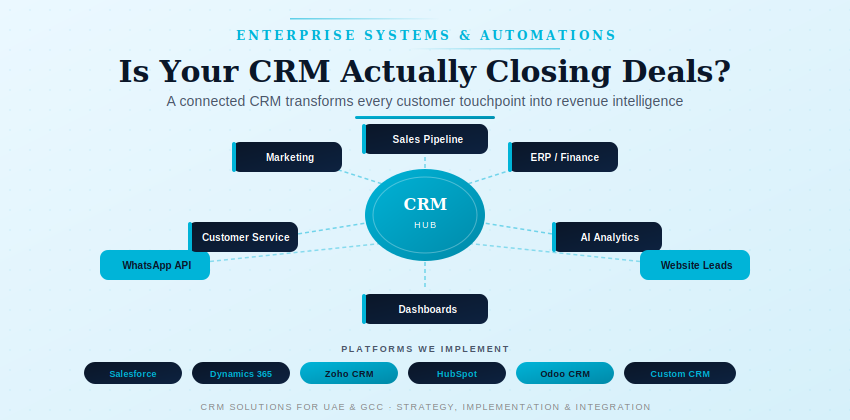
Innate Technologies works with the leading CRM platforms in the UAE and GCC market. Here is how they compare across the key dimensions relevant to regional businesses:
Salesforce
The global market leader. Unmatched depth of functionality and ecosystem. Ideal for large enterprises with complex, multi-department CRM requirements and significant IT resources. Strong presence across UAE financial services and enterprise accounts.
Microsoft Dynamics 365
The natural choice for organisations already invested in the Microsoft ecosystem (Office 365, Azure, Teams). Deep ERP-CRM integration via Dynamics 365 Business Central makes it particularly strong for UAE manufacturing, trading, and distribution companies.
Zoho CRM
The strongest value proposition for UAE and GCC SMEs. Comprehensive feature set at a fraction of the cost of Salesforce or Dynamics. Zoho's new Middle East data centres address data residency requirements directly. Excellent for fast-growing businesses needing rapid deployment.
HubSpot CRM
The preferred platform for marketing-led organisations — particularly SaaS companies, professional services firms, and businesses where inbound marketing and content-driven lead generation are primary growth channels. Free tier makes it accessible for early-stage businesses.
Odoo CRM
Innate's recommended platform for businesses that need CRM tightly integrated with ERP, inventory, accounting, and operations in a single system. Particularly strong for UAE trading, retail, and manufacturing companies already on or considering Odoo ERP.
Custom CRM Development
For businesses with highly specific workflows that no standard platform can accommodate efficiently, Innate designs and builds lightweight custom CRM solutions — typically on open-source or Microsoft technology stacks — that fit the business exactly as it operates.
CRM in the GCC: What Makes This Market Different
Implementing a CRM in the UAE, Saudi Arabia, Qatar, or Kuwait is not the same as implementing one in Europe or North America. The GCC market has specific dynamics that must be reflected in how a CRM is configured and deployed:
Relationship-First Sales Culture
Business in the GCC is built on trust and personal relationships in a way that is more pronounced than in most Western markets. A CRM for this environment must capture the relationship context — not just the commercial pipeline. Who referred the client, which events they attended, personal milestones, and communication history are all data points that matter for account management in this culture. CRM configuration that ignores this produces a system the local sales team will resist.
Arabic Language and Bilingual Requirements
Customer-facing communications, documents, and reports generated from the CRM often need to be produced in both Arabic and English. CRM platforms must be evaluated for their Arabic language support — particularly right-to-left text rendering, Arabic email templates, and bilingual reporting. This is an area where implementation experience in the GCC makes a tangible difference.
Multi-Entity and Multi-Country Operations
Many businesses operating out of the UAE have entities across the GCC — a parent company in Dubai with subsidiaries or branches in Saudi Arabia, Qatar, and Bahrain. CRM configuration must support multi-entity structures, with appropriate data segregation, consolidated reporting, and role-based access that reflects the organisational hierarchy across borders.
UAE PDPL and Saudi Arabia PDPL Compliance
Both the UAE Personal Data Protection Law and Saudi Arabia's PDPL impose obligations on how customer data is stored, processed, and transferred. CRM deployments must be configured with data residency, consent management, and access control in mind from the outset. Zoho's Middle East data centres and Microsoft's UAE Azure regions directly address this for their respective platforms.
WhatsApp as a Primary Business Communication Channel
In the UAE and GCC, WhatsApp is not just a consumer app — it is a primary channel for business communication, customer enquiries, and sales conversations. A CRM implementation that does not integrate with WhatsApp Business API is missing the channel where a significant portion of customer interaction actually happens. Innate configures WhatsApp Business integrations as a standard component of CRM deployments for customer-facing businesses in the region.
How Innate Technologies Delivers CRM Solutions in UAE and GCC
At Innate Technologies, our CRM practice is built on a business-first principle: we understand how your organisation actually sells, services customers, and manages relationships before we touch a single system configuration. Too many CRM implementations fail because the technology is set up first and the business process is adapted to fit it. We work the other way around.
Industries Where CRM Delivers the Greatest Impact in the GCC
While CRM adds value across virtually every sector, the following industries in the UAE and GCC see particularly strong returns from a well-implemented CRM:
Real Estate & Property
Long sales cycles, multiple stakeholders, and high transaction values make CRM essential for UAE real estate businesses. Pipeline management, broker performance tracking, lead source attribution, and automated follow-up workflows directly impact revenue in this sector.
Retail & E-Commerce
With UAE retail sales reaching AED 120 billion and growing, customer data is the competitive asset. CRM enables personalisation, loyalty programme management, repeat purchase campaigns, and customer lifetime value analysis that generic POS systems cannot provide.
Professional Services
Law firms, consultancies, audit firms, and engineering companies in the GCC use CRM to manage client relationships across long engagement cycles. Opportunity tracking, proposal management, referral attribution, and client satisfaction monitoring are all CRM use cases with direct revenue impact.
Healthcare & Clinics
Private clinics and healthcare groups across Dubai and Abu Dhabi use CRM to manage patient acquisition, appointment follow-up, insurance coordination, and patient retention — combining it with patient management systems to create a complete view of the patient relationship.
Automotive
UAE automotive dealerships manage high-value, relationship-driven sales cycles across new vehicle sales, used vehicles, service, and parts. CRM enables lead tracking from showroom visit or online enquiry through to handover, service reminders, and renewal campaigns.
Trading & Distribution
B2B trading companies in the UAE — handling multiple product lines, multiple customer accounts, and complex pricing structures — use CRM to manage account coverage, order history, credit terms, and sales territory performance in a way that spreadsheets simply cannot sustain at scale.
Conclusion: A CRM Should Drive Revenue, Not Just Record It
The CRM adoption gap in the UAE and GCC is not a technology problem. The platforms are powerful, accessible, and increasingly well-suited to the regional market. The gap is an implementation gap — between businesses that have a CRM installed and businesses that have a CRM working.
The difference shows up in the numbers. A properly implemented CRM boosts revenue by up to 29%, improves sales forecasting accuracy by 32%, and increases team productivity by 40%. These are not theoretical gains — they are outcomes consistently achieved by businesses that invest not just in the software, but in the strategy, configuration, integration, and training that make the software actually work.
For businesses in the UAE and GCC, where relationship management is at the core of how commerce works, a CRM that reflects the way the business actually operates — in Arabic and English, integrated with WhatsApp, connected to ERP and accounting, and configured around the real sales process — is one of the highest-return technology investments available.
Talk to Innate Technologies About Your CRM
Innate Technologies provides CRM strategy, platform selection, customisation, integration, and training for businesses across Dubai, UAE, and the wider GCC. Whether you are implementing a CRM for the first time or need to fix one that is not delivering results, our team is ready to help. Get in touch with our team to start a conversation.