
Four in five GCC organisations already have an AI strategy, yet only about a third have an enterprise-wide data foundation to run it. The businesses that win with AI in the UAE, Saudi Arabia and Qatar will not be the ones with the best model - they will be the ones with the best data.
Walk into almost any large organisation in Dubai, Riyadh or Doha and you will hear the same story. An AI strategy is approved. A budget is released. A vendor is selected and a pilot is launched. Three months later the demo looks impressive. Nine months later it is still a demo.
The model was rarely the problem. The problem is what the model was fed: customer records duplicated across three systems, finance data that does not match operations data, documents nobody has classified, and no clear owner for any of it. Garbage in, confident-sounding garbage out.
This is the AI readiness illusion - confidence in the strategy and the tools, without the data foundation underneath. And across the GCC, it is widening as spending accelerates.
The Numbers: GCC AI Ambition Is Outrunning Data Readiness
4 in 5
GCC Organisations Have an AI Strategy
34%
Have an Enterprise-Wide Data Foundation
85%
Expect Higher AI Budgets in 2026
28%
Have an AI Ethics or Compliance Board
77%
UAE Leaders Cite Data Accuracy, Access or Management as an AI Barrier
13%
UAE Public Sector Organisations Have Scaled AI
33%
Saudi Public Sector Organisations Have Scaled AI
105%
Projected Growth in UAE AI Spending
Sources: Roland Berger GCC AI research, ServiceNow UAE research, Capgemini Research Institute
The pattern is consistent. Roland Berger's GCC research shows most organisations have an AI strategy and expect bigger budgets, yet only about a third have a data foundation that spans the enterprise. ServiceNow's regional research found that 77% of UAE leaders cite data accuracy, access or management as a barrier to AI, even as UAE AI spending is set to more than double. Capgemini's public sector findings show the scale gap: only 13% of UAE and 33% of Saudi public sector organisations have taken AI beyond pilots.
Cloudera's Data Readiness Index for Saudi Arabia adds the detail behind the headline:
32%
of Saudi Organisations Have Full Data Visibility
62%
Report Data Access Restrictions
29%
Cite Weak Workflow Integration
50%
Report Low Data Literacy
About 32% of Saudi organisations also have no executive sponsor for data, and only 35% give data ownership to the CIO or CTO, against 69% across EMEA. Data readiness is as much an ownership problem as a technology one.
The Six Data Foundations Every GCC AI Programme Needs
Before any model is trained or any agent is deployed, six foundations decide whether AI delivers value or stalls in pilot. Most businesses in the region are strong on one or two and weak on the rest.
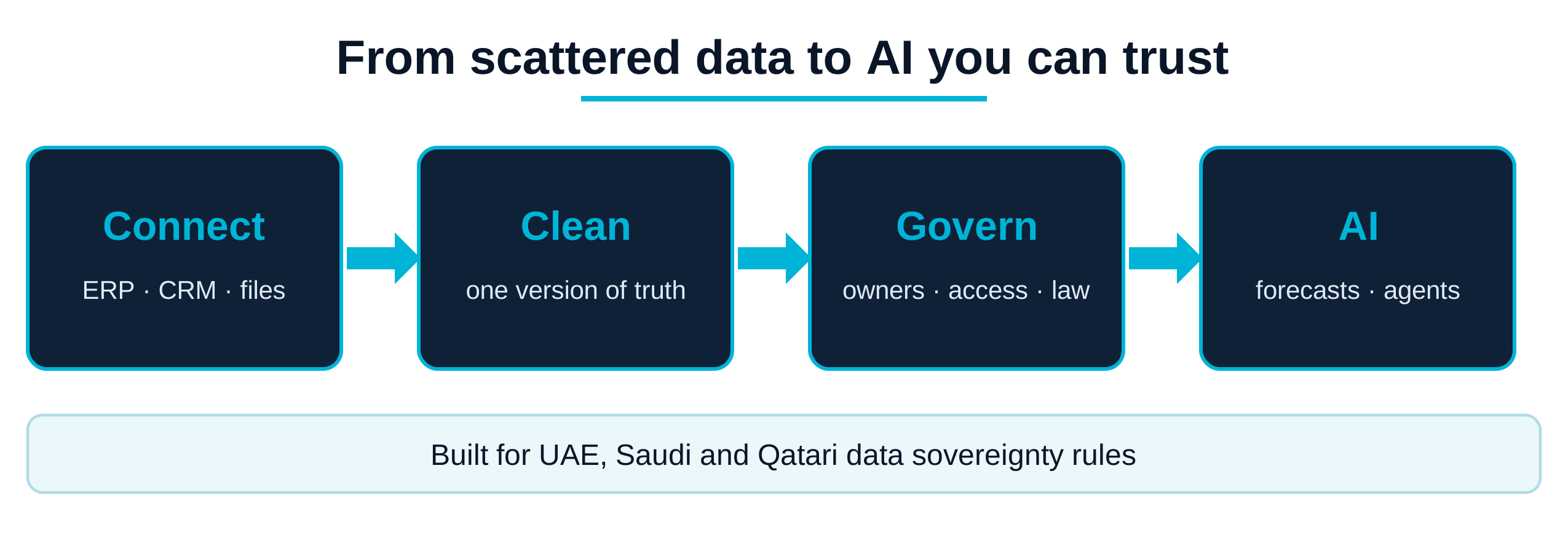
CONNECTED
One view of the truth
AI needs a unified view of the customer, asset or transaction. Siloed ERP, CRM and spreadsheets produce partial answers and conflicting numbers.
CLEAN
Accurate and consistent
Duplicates, missing fields and mixed Arabic and English formats quietly degrade every model and report. Quality has to be fixed at source, not patched downstream.
GOVERNED
Owned and controlled
Clear ownership, access rules, lineage and classification, so people and AI agents only see the data they should.
SOVEREIGN
Compliant by design
Data stored, processed and transferred in line with UAE, Saudi and Qatari law - including when it is sent to cross-border AI services.
OWNED
Sponsored and trusted
A named executive sponsor and a data-literate team who trust the data and use it in daily decisions.
ACCESSIBLE
Reachable by AI
Secure, API-ready access so AI can use live business data instead of stale exports and email attachments.
The GCC Twist: Data Sovereignty Is an AI Decision
In most markets, data readiness is a quality question. In the GCC it is also a legal one, because the AI tool you choose decides where your data travels.
- Saudi Arabia: the Personal Data Protection Law has been enforceable since September 2024, with strict conditions on transferring personal data outside the Kingdom. SDAIA continues to consult on further rules, so requirements are still evolving.
- UAE: Federal Decree-Law 45 of 2021 governs personal data processing and places obligations on processors as well as controllers. Financial institutions also face Central Bank requirements on operational resilience and on where critical records are held.
- Qatar: Law 13 of 2016 governs personal data, and regulated sectors such as banking face additional rules on cloud and outsourcing.
- Bahrain, Kuwait and Oman: each has its own data protection regime, so a regional rollout needs country-by-country checks rather than a single policy.
The practical consequence is simple. Before sending customer, employee or financial data to a public AI service, confirm where it is processed, who can access it and whether the transfer is lawful. Check the current text of each regulation with your legal team, as these rules are changing quickly.
Where Poor Data Breaks AI in GCC Industries
The same data gaps show up differently by sector. These are the five where we see the most friction:
A Practical AI Data Readiness Checklist
Ask your leadership team these six questions before approving the next AI investment:
- Can you list your top five data sources and who owns each one?
- Do customer, product and finance records match across ERP, CRM and reporting?
- Is sensitive data classified, and do you know where it is stored and processed?
- Can an AI tool reach live data securely through APIs, rather than through exported files?
- Is there an executive sponsor accountable for data quality and AI outcomes?
- Have you mapped each planned AI use case to UAE, Saudi or Qatari data rules?
If you answered no to three or more, fix the data before you scale the AI. It will be faster and cheaper than the alternative.
How Innate Technologies Helps GCC Businesses Get AI-Ready
At Innate Technologies, our Data, AI & Intelligent Solutions practice is built around a simple principle: AI should run on data you can trust. From our base in Dubai & Doha, we help businesses across the UAE and GCC build that foundation and then put it to work.
- Data Strategy & Architecture: Designing the platform, ownership model and roadmap that your AI use cases actually need, on Azure, AWS or Google Cloud.
- System Integration: Connecting Odoo ERP, CRM, finance and legacy systems so data flows in one direction and every team works from the same numbers.
- Business Intelligence & Predictive Analytics: Turning clean data into dashboards and forecasts your teams trust - the descriptive and predictive layers that sit on top of a solid foundation.
- Data Governance & Security: Classification, access control and sovereignty-aware design, aligned with UAE, Saudi and wider GCC requirements.
- AI Readiness Assessment: An honest review of your data, systems and use cases before you invest in a pilot, with a prioritised plan of what to fix first.
Where to Start: One Use Case, Fixed End to End
Do not try to make the whole organisation AI-ready at once. Pick one high-value use case - demand forecasting, document processing, lead scoring or customer service automation. Trace every data source it needs. Fix that data end to end, prove the result, and then repeat.
The worst first move is buying a platform and hoping the data catches up. The best is a focused project with clean data, a named owner and a measurable outcome.
Conclusion: Fix the Foundation Before You Scale
The GCC has made AI a national priority, and the investment is real. But the organisations that turn that investment into results will be the ones that treat data as a strategic asset: connected, clean, governed, sovereign and owned.
The question is not whether your business will use AI. It is whether your data will be ready when it does - and whether you will find out before or after the pilot fails.
Find Out If Your Data Is Ready for AI
Innate Technologies helps businesses across Dubai, UAE, and the GCC build the data foundation that AI depends on - from data strategy and integration to governance and AI readiness assessments. Get in touch to schedule a free discovery conversation.
Tags: AI data readiness UAE, AI readiness GCC, data quality for AI, data governance UAE, data sovereignty GCC, Saudi PDPL AI, UAE PDPL, AI strategy Dubai, enterprise data strategy UAE, AI readiness assessment Dubai, data integration UAE, AI for business UAE, data analytics Dubai, AI adoption Saudi Arabia, AI consulting Dubai