Page-one Google rankings no longer guarantee that customers find you. With 58% of users now turning to AI tools before search engines, the businesses winning in the GCC are optimising for a fundamentally different game — one where the goal is not a click, but a citation.
Search Has Changed. Most UAE Businesses Have Not
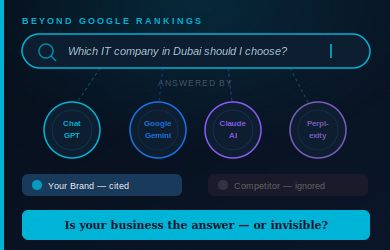
Picture this: a procurement manager at a Dubai trading company needs a new ERP implementation partner. Five years ago, she opened Google and typed 'ERP consultant Dubai'. Today, she opens ChatGPT and asks: 'Which ERP implementation companies in Dubai have experience with manufacturing and trading businesses?' She reads the AI's synthesised answer, considers the two or three names it cites with confidence, and starts making calls.
Your business may rank number one on Google for 'ERP consultant Dubai'. But if ChatGPT, Gemini, or Claude does not cite you when that question is asked, you do not exist in her decision process.
This is the new reality of search - and it is arriving faster than most businesses in the UAE and GCC have recognised.
58%
Users Now Use AI Before Search Engines
69%
Google Searches Now End Without a Click
527%
AI Referral Traffic Growth Jan–May 2025
15.9%
Conversion Rate: ChatGPT Referrals
40%
GEO Visibility Lift
(Princeton Study 2024)
98%
of CMOs Investing in AEO/GEO 2026
4.4x
UAE: AI Referral Conversion vs Organic
60%%
of Information Retrieval Now AI-Driven (Q1 2026)
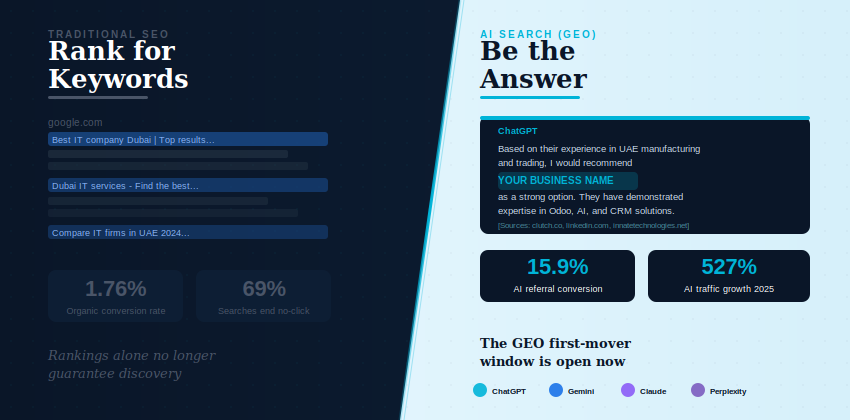
The numbers tell a clear story. AI-referred sessions grew 527% between January and May 2025 alone. Zero-click searches on Google — where users get an answer from an AI Overview without visiting any website - climbed from 56% to 69% in a single year following Google's AI Overviews launch. And critically for business: visitors arriving from ChatGPT convert at 15.9% compared to the 1.76% average from traditional organic search. These are not people browsing — they are buyers with a shortlist already forming.
For businesses in the UAE and GCC, the first-mover advantage is significant. By Q1 2026, 98% of CMOs globally are investing in AI search optimisation strategies — but most UAE SMEs and mid-market businesses have not yet started. The gap between businesses that appear in AI answers and those that do not is widening every month.
SEO vs GEO vs AEO: Understanding the New Search Landscape
The industry has not yet settled on a single term. You will encounter GEO (Generative Engine Optimisation), AEO (Answer Engine Optimisation), and LLM Optimisation used interchangeably. They all describe the same goal: getting your business cited by AI when potential customers ask questions in your category. Here is how the three layers of modern search visibility relate to each other:
Traditional SEO
Optimising web pages to rank in Google's list of blue links. Goal: a click. Measured by: ranking position, organic traffic, CTR. Still essential — because AI systems largely draw from Google-indexed content.
GEO / AEO
Optimising content to be cited, quoted, or recommended inside AI-generated answers. Goal: a citation. Measured by: brand mention frequency across AI platforms, AI-referred traffic, share of voice in AI responses.
LLM Optimisation
Ensuring your brand is represented accurately in the training data and live retrieval systems of large language models (ChatGPT, Gemini, Claude, Perplexity). Goal: authoritative brand entity. Measured by: brand citation accuracy, sentiment, and consistency across models.
The critical insight: these three layers are not alternatives — they are additive. Strong traditional SEO is the foundation that makes GEO possible. Content that ranks well in Google tends to be cited more frequently by AI systems, particularly Gemini and Google AI Overviews, which draw directly from Google's index. But GEO adds a layer of structural, topical, and authority signals that go beyond keyword ranking - and that is where significant competitive advantage is available for UAE businesses today.
How Each AI Platform Finds and Cites Your Business
Each major AI search platform has a distinct retrieval architecture, citation preference, and content weighting model. Understanding these differences is essential for building a GCC visibility strategy that works across all of them - not just one.
ChatGPT (OpenAI)
HOW IT FINDS CONTENT
Uses Retrieval Augmented Generation (RAG) with live web search via OAI-SearchBot and ChatGPT-User crawlers. Breaks queries into multiple sub-queries and synthesises answers from across sources. Heavily favours 'earned' domains - third-party publications, directories, and authoritative references (93.5% earned sources vs direct brand pages).
WHAT IT WEIGHTS MOST
Specific, citable facts and statistics that cannot be synthesised from training data alone. Named expert attribution. Third-party mentions in industry publications, awards, and directories. Breadth of coverage across multiple authoritative sources. Product usage data and customer base signals.
GCC WINNING TACTIC
Get cited in UAE business directories, industry awards, and respected regional publications. Publish articles containing specific, verifiable statistics with source attribution. Ensure your brand appears consistently across multiple independent domains - not just your own website.
Google Gemini & AI Overviews
HOW IT FINDS CONTENT
Draws directly from Google's search index, making it the most SEO-adjacent AI platform. AI Overviews appear on 69% of all Google searches as of Q1 2026. Gemini looks for brands that appear consistently across multiple ranked lists and directories — not just the top-ranking single result. Places higher weight on Google Business Profile authority and local reviews.
WHAT IT WEIGHTS MOST
Strong Google domain authority. Consistent appearance across multiple top-ranked lists, comparison sites, and directories. Google Business Profile with strong reviews (minimum 4.0 stars). Schema markup (FAQ, HowTo, Organisation, LocalBusiness). Citation as 'award-winning' in third-party content. Core Web Vitals compliance.
GCC WINNING TACTIC
Prioritise Google Business Profile optimisation — Gemini integrates local business signals directly into AI answers. Pursue legitimate industry awards and rankings that get published on high-authority domains. Implement comprehensive Schema.org structured data across all service pages.
Perplexity AI
HOW IT FINDS CONTENT
Real-time web search with heavy citation transparency — Perplexity shows its sources clearly, making it the most citation-visible platform for tracking. Strong preference for recent, up-to-date content. Also incorporates social content more than ChatGPT or Claude (23.8% social sources vs 6.8% for Claude). Has the highest conversion rates for SaaS and B2B products.
WHAT IT WEIGHTS MOST
Content recency — Perplexity strongly prefers recently published or updated content. Clear answer-first structure where the key fact appears at the top of the page. High-quality technical and informational content rather than promotional copy. Social proof signals including Reddit mentions and forum discussions.
GCC WINNING TACTIC
Publish a consistent programme of updated, date-stamped content. Structure articles with the direct answer to the likely query in the first paragraph. Build authentic community presence on LinkedIn and professional forums — Perplexity includes social content in its citations.
Claude (Anthropic)
HOW IT FINDS CONTENT
Synthesises information rather than quoting directly. Uses live retrieval via Claude-SearchBot and Claude-User crawlers for current queries. Relies heavily on encyclopaedias, established directories, and trusted compendiums. Favours earned, authoritative domains (87.3% earned sources). Does not typically recommend local businesses from web search — relies more on established reference sources.
WHAT IT WEIGHTS MOST
Depth and comprehensiveness of coverage — Claude prefers content that explores topics thoroughly rather than superficially. Coverage in established reference sources, industry bodies, and professional associations. Ethical and responsible positioning — Claude weights content that addresses nuance, risk, and responsible use. Consistent expert positioning across multiple independent sources.
GCC WINNING TACTIC
Focus on building citations in established industry bodies, professional associations, and UAE government-adjacent organisations. Publish genuinely comprehensive, long-form content that demonstrates subject matter depth. Ensure your brand is listed in Clutch, G2, and established B2B review platforms — Claude draws on these as reference compendiums.
What Makes GEO in the GCC Different from Western Markets
Implementing GEO for a business in Dubai or Riyadh is not the same as implementing it for a business in London or New York. The GCC market has specific dynamics that must be addressed in any AI visibility strategy:
Arabic Language AI Search Is the Biggest Opportunity Right Now
Following Google I/O 2026, Google's AI features now operate natively in Arabic for the first time — and the citation pool for Arabic-language AI answers is extraordinarily thin. The GCC is one of the world's highest smartphone penetration markets (UAE smartphone penetration exceeds 97%), yet until recently, AI search in the region operated almost exclusively in English. Businesses that build Arabic-language, AI-optimised content now will dominate GCC AI search visibility for years. This means implementing bilingual Organisation schema with Arabic name, description, and address fields; creating Arabic FAQ schema targeting formal Arabic (Fusha) query patterns; and submitting dedicated Arabic sitemaps to Search Console.
Bilingual E-E-A-T Signals Are Non-Negotiable
Google's E-E-A-T framework (Experience, Expertise, Authoritativeness, Trustworthiness) — a core GEO ranking signal — must be demonstrated in both English and Arabic for GCC businesses serving bilingual audiences. This means bilingual author bios with verifiable credentials, content that references UAE-specific regulatory frameworks (PDPL, DHA, RERA, DIFC), and Arabic-language customer testimonials from named, verifiable clients.
GCC Directory Presence Is a Citation Multiplier
AI systems, particularly ChatGPT and Gemini, weight brand mentions across multiple independent sources heavily. For UAE businesses, this means maintaining accurate, consistent presence across UAE-specific directories and platforms: Yellow Pages UAE, Dubai Chamber of Commerce directory, DIFC or ADGM business registers, Clutch.co with UAE-verified reviews, and Google Business Profile with Arabic and English descriptions. A business cited across eight independent credible sources is exponentially more likely to appear in AI answers than one that only appears on its own website.
WhatsApp and Social Signals Matter for Perplexity
Unlike ChatGPT and Claude, Perplexity incorporates social signals including LinkedIn posts, professional forum discussions, and community platforms at a meaningful rate (23.8% social content in citations). For GCC businesses where WhatsApp is the primary business communication channel and LinkedIn is a major professional discovery platform, this means building a consistent social content programme that generates discussion and shared content — not just publishing and disappearing.
Free Zone and Industry Certifications Are AI Authority Signals
AI systems interpret awards, certifications, and institutional affiliations as authority signals — particularly when mentioned by third-party sources. UAE businesses with DIFC, DMCC, or ADGM registration, ISO certifications, or industry body memberships (like UAE chapters of global professional associations) should ensure these credentials are mentioned consistently in external publications, press coverage, and directory listings — not just on their own websites.
Technical GEO: What Your Website Must Get Right
GEO has a technical layer that often gets overlooked because it sits between traditional SEO and developer responsibilities. These are the technical foundations that determine whether AI crawlers can find, read, and cite your content:
The Content Strategy That Gets UAE Businesses Cited by AI
Content is where GEO is won or lost. The following content types and approaches consistently generate AI citations across ChatGPT, Gemini, Perplexity, and Claude - and are particularly relevant for B2B businesses operating in the UAE and GCC:
Definitive Industry Guides
Long-form (2,500–3,500 word) comprehensive guides that cover a topic more thoroughly than any competing page. AI systems cite comprehensive sources because they can extract multiple relevant answers from a single authoritative document. For UAE businesses, this means guides like 'The Complete Guide to VAT Compliance for UAE SMEs' or 'How to Choose an ERP System for UAE Manufacturing Companies' — specific, authoritative, and regionally focused.
Data-Led Original Research
AI systems are specifically attracted to content containing specific statistics, named sources, and verifiable data. Original research — even a survey of 50 UAE business owners — provides the kind of citable, non-synthesisable data that generates citations. Publish annual benchmark reports, regional market analyses, or industry surveys relevant to your sector. These become citation magnets across all AI platforms.
Conversational FAQ Content
Structure FAQ pages around the exact questions your customers ask AI tools — not the keywords they type into Google. There is a fundamental difference: 'ERP software UAE' (keyword) vs 'What ERP system is best for a trading company in Dubai with 50 employees?' (conversational query). Use tools like AnswerThePublic, Reddit, and LinkedIn comments to identify the actual questions being asked in your category. Then answer them directly, completely, and specifically.
Named Expert Commentary
AI systems weight content where named, credible individuals are quoted with verifiable credentials. Anonymous company content has lower citation probability than content attributed to 'Ahmed Al Rashidi, CPA with 15 years of UAE tax advisory experience at [Company]'. Develop a programme of expert-authored content where team members are bylined on articles in their area of genuine expertise — and ensure their LinkedIn profiles reflect and validate those credentials.
Comparison and Versus Content
When a buyer asks an AI 'Salesforce vs Dynamics 365 for a UAE real estate company', the AI looks for content that directly addresses that comparison. Create structured comparison content for your most competitive decision moments — your service vs alternatives, different approaches to the problem you solve, platform comparisons relevant to your space. This content captures buyers at the highest-intent moment in their decision process.
Regular Content Updates with Date Signals
Perplexity and ChatGPT with live search strongly favour recently published or updated content. Every piece of content should have a visible publication and last-updated date. Establish a quarterly review cycle where your most important pages are refreshed with current statistics, updated examples, and new insights. AI systems track content freshness as a trust signal - stale content loses citation share over time.
How to Measure AI Search Visibility for Your GCC Business
Traditional SEO measurement is mature - Google Search Console, rank trackers, and analytics provide clear data on ranking positions, click-through rates, and traffic. GEO measurement is newer and requires a different approach:
- Define Your AI Query Set: Identify the 20–30 conversational questions your target customers in the UAE and GCC are most likely to ask AI tools about your service category. Include both English and Arabic versions. These become your measurement benchmark.
- Run Weekly Prompt Tests: Execute those queries manually across ChatGPT, Gemini, Perplexity, and Claude at least weekly. Record whether your brand appears, what position, how it is described, and what sources are cited. Build a simple spreadsheet tracking your brand's AI mention rate over time.
- Track AI-Referred Traffic in GA4: In Google Analytics 4, AI platforms appear as referral traffic sources. Filter for referrals from chatgpt.com, perplexity.ai, gemini.google.com, and claude.ai. Track conversion rates from these sources — AI-referred visitors typically convert significantly higher than organic search visitors.
- Monitor Brand Sentiment in AI: When your brand is cited, note how it is described. AI systems build entity associations — positive attributions accumulate over time if your content signals are strong. Negative descriptions (from review platforms or critical press coverage) also accumulate. Address both proactively.
- Measure AI Bot Traffic: Server logs and tools like Cloudflare show AI crawler visits (OAI-SearchBot, PerplexityBot, Claude-SearchBot, Googlebot). Increasing AI bot visits to key service pages indicates growing citation probability. Monitor which pages AI crawlers visit most and prioritise GEO optimisation there first.
Conclusion: The First-Mover Window Is Open - But Not for Long
Search is not broken. But it has fundamentally changed. The businesses that dominated Google search results in 2020 are not automatically the businesses that dominate AI search results in 2026. The ranking factors are different. The content requirements are different. The measurement frameworks are different.
For UAE and GCC businesses, the timing is genuinely advantageous. Most regional SMEs and mid-market companies have not yet implemented GEO strategies. The Arabic-language AI citation pool is thin. The technical requirements — allowing the right AI crawlers, implementing schema markup, structuring content for AI retrieval - are achievable. And the conversion premium from AI-referred traffic (15.9% from ChatGPT vs 1.76% from organic search) means that even a small share of AI citations delivers outsized commercial value.
The businesses that act now — building topical authority, structured content, bilingual entity signals, and cross-platform citation presence - will be the ones that AI tools cite by default when GCC buyers ask the questions that matter. The window for first-mover advantage is open. It will not stay open indefinitely.
Build Your AI Search Visibility with Innate Technologies
Innate Technologies helps UAE and GCC businesses build digital visibility across both traditional search and AI platforms — from technical SEO and schema implementation to GEO content strategy and performance optimisation. Whether you are starting from scratch or looking to extend an existing SEO programme into AI search, our team can help. Get in touch with our team to start a conversation.