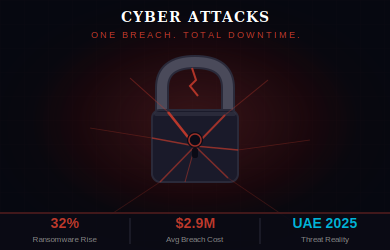
Ransomware up 32%. Malware detections up 65%. Average breach cost $2.9 million. The UAE is now the second most targeted country in the Middle East — and most businesses are not as protected as they think.
The UAE Cyber Threat Landscape: What the Numbers Tell Us
It can happen on a Tuesday morning. A single employee opens a convincing email. Within minutes, files across your network are encrypted. Your ERP is offline. Your customer database is inaccessible. Your operations have stopped — completely.
This is not a hypothetical. It is the lived experience of businesses across the UAE in 2024 and 2025. And the frequency, sophistication, and financial damage of these attacks is accelerating at a pace that many organisations are not prepared for.
32%
Rise in Ransomware
Attacks in 2024
65.3%
Surge in Malware
Detections 2024
$2.9M
Avg Cost Per
Cyber Incident UAE
$8.7M
Avg Data Breach Cost
Middle East
200K+
Cyberattacks Blocked
Daily by UAE Council
12%
of All MENA Attacks
Target UAE
98%
of Breaches Involve
Human Error
75%
Rise in Email
Impersonation 2024
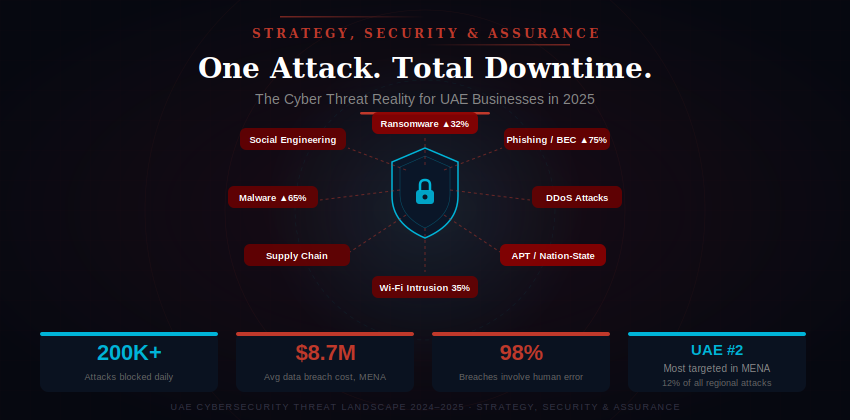
The UAE Cyber Security Council now blocks more than 200,000 cyberattacks every day, defending against threats from over 14 countries. Despite this, the UAE became the second most targeted country in the Middle East in 2024, facing 12% of all cyberattacks in the region. Between January and November 2024 alone, 34 ransomware incidents were recorded — up from 27 for the entire year of 2023.
The financial services sector has been particularly hard hit. According to the State of the UAE Cybersecurity Report 2025, 21% of all cybersecurity incidents targeted banks and financial services. But the threat is not limited to large financial institutions — retailers, healthcare providers, logistics companies, and SMEs are increasingly being targeted precisely because their defences tend to be weaker.
Perhaps most sobering of all: 98% of successful cyberattacks exploit human error rather than purely technical vulnerabilities. No amount of firewall investment protects a business whose employees are not trained to recognise a phishing email.
The Seven Most Dangerous Cyber Attack Types Targeting UAE Businesses
Understanding the specific nature of each threat is the first step towards effective defence. Here are the attack types causing the most damage to organisations in the UAE and GCC:
01. Ransomware
SEVERITY
CRITICAL
CRITICAL
HOW IT WORKS
Ransomware is malicious software that infiltrates a network — typically through a phishing email, compromised credential, or unpatched vulnerability — and encrypts files and systems, rendering them completely inaccessible. Attackers then demand a ransom payment, often in cryptocurrency, in exchange for a decryption key. Modern ransomware groups such as RansomHub, DarkVault, and Qilin — all active in the UAE in 2024 — also threaten to publish stolen data publicly if the ransom is not paid, a tactic known as double extortion.
BUSINESS IMPACT
Complete operational shutdown. All files, databases, and applications become inaccessible within minutes. Average recovery time without backups: 3–4 weeks. Average ransom demand for SMEs: $150,000–$500,000. Beyond the ransom, businesses face lost revenue, regulatory penalties, reputational damage, and emergency IT costs. In the UAE, ransomware attacks increased 32% in 2024.
PREVENTION MEASURES
•
Maintain offline, encrypted, regularly-tested backups — completely isolated from the primary network
•
Implement multi-factor authentication (MFA) across all systems and remote access points
•
Apply security patches and updates within 72 hours of release — most ransomware exploits known vulnerabilities
•
Segment your network so a compromise in one area cannot spread across the entire organisation
•
Deploy endpoint detection and response (EDR) tools that detect and isolate threats before encryption begins
•
Conduct regular employee security awareness training focused on recognising phishing and suspicious attachments
02. Phishing & Spear Phishing
SEVERITY
VERY HIGH
VERY HIGH
HOW IT WORKS
Phishing is the use of deceptive emails, messages, or websites that impersonate trusted entities — banks, government bodies, senior executives, or well-known brands — to trick recipients into revealing credentials, clicking malicious links, or transferring funds. Spear phishing is a targeted variant where attackers research the victim and personalise the attack to their specific role, relationships, and context. Email impersonation attacks in the UAE rose 75% in 2024. CEO fraud — where attackers impersonate a company’s executive to authorise urgent wire transfers — has caused substantial financial losses across UAE businesses.
BUSINESS IMPACT
Direct financial loss through fraudulent transfers (UAE businesses lost an average of $2.9 million per incident). Credential theft leading to deeper network compromise. Customer data exposure triggering PDPL and regulatory penalties. In 2024, phishing was the entry vector for the majority of ransomware attacks recorded in the UAE.
PREVENTION MEASURES
•
Train all employees to verify payment requests and credential-seeking communications through a second channel
•
Implement email authentication protocols — DMARC, DKIM, and SPF — to prevent domain spoofing
•
Deploy AI-powered email filtering that identifies and quarantines suspicious messages before they reach inboxes
•
Establish a clear internal policy: financial transfers above a defined threshold require voice confirmation from the requester
•
Conduct regular phishing simulation exercises to test and improve employee vigilance
03. DDoS (Distributed Denial of Service) Attacks
SEVERITY
HIGH
HIGH
HOW IT WORKS
A Distributed Denial of Service attack floods a target’s servers, network, or website with overwhelming volumes of traffic — rendering them unable to respond to legitimate requests. In March 2024, Anonymous Sudan launched coordinated DDoS attacks against First Abu Dhabi Bank, RAKBANK, and Mashreq Bank, temporarily taking their online banking services offline. DDoS attacks can be sustained for hours or days, and are increasingly used as cover for simultaneous, more targeted intrusion attempts.
BUSINESS IMPACT
Complete website and online service unavailability, directly impacting customer experience, e-commerce revenue, and brand reputation. For financial services and healthcare, even hours of downtime carries regulatory and operational consequences. The attack itself may be a distraction while another threat vector is being exploited simultaneously.
PREVENTION MEASURES
•
Implement DDoS mitigation services (cloud-based scrubbing services that absorb and filter attack traffic before it reaches your infrastructure)
•
Configure rate limiting and traffic anomaly detection at the network layer
•
Work with your hosting provider to establish a response plan and failover capacity
•
Maintain an incident response plan specifically addressing DDoS scenarios, including communication templates for customers
04. Business Email Compromise (BEC) & CEO Fraud
SEVERITY
HIGH
HIGH
HOW IT WORKS
BEC attacks involve criminals gaining access to — or convincingly impersonating — a legitimate business email account, typically belonging to a senior executive or finance team member. They then use this position to issue instructions for fraudulent wire transfers, vendor payment redirections, or payroll account changes. In the UAE, where business culture places significant trust in executive directives, BEC attacks have been particularly effective. Smaller businesses are disproportionately vulnerable because they often lack the formal approval processes that larger organisations use to verify financial instructions.
BUSINESS IMPACT
Direct and often unrecoverable financial losses. Wire transfer fraud is typically irreversible once funds leave UAE jurisdiction. Average BEC losses for regional SMEs range from AED 200,000 to AED 2 million per incident. Beyond financial loss, BEC attacks damage vendor relationships and can trigger audit requirements under UAE financial regulations.
PREVENTION MEASURES
•
Require out-of-band verification (phone call to a known number) for all payment instructions received via email
•
Implement email security that flags messages from external senders impersonating internal domains
•
Establish dual-approval processes for all financial transactions above a defined threshold
•
Educate finance and procurement teams on the specific patterns of BEC attacks — urgency, secrecy, unusual payment destinations
•
Regularly audit and review vendor bank account details through official channels before processing payments
05. Wi-Fi & Network Intrusion
SEVERITY
HIGH
HIGH
HOW IT WORKS
In early 2025, the UAE recorded over 12,000 Wi-Fi breaches — accounting for 35% of all cybersecurity incidents during that period. Attackers exploit poorly secured wireless networks, use rogue access points to intercept communications, or leverage unencrypted public Wi-Fi connections to capture credentials and sensitive data. For businesses with open or weakly-secured guest networks, or employees working from hotels and cafes, the risk is significant. Network intrusions often serve as the initial foothold for deeper attacks including ransomware deployment and data exfiltration.
BUSINESS IMPACT
Network intrusion provides attackers with persistent access to internal systems, enabling data theft, lateral movement across the network, and the deployment of additional malware. Organisations may not discover an intrusion for weeks or months — during which time sensitive data is being exfiltrated continuously.
PREVENTION MEASURES
•
Implement WPA3 encryption on all wireless networks and segment guest networks completely from corporate systems
•
Deploy a wireless intrusion detection system (WIDS) that identifies rogue access points and anomalous connections
•
Require VPN usage for all remote access and any work conducted outside the office environment
•
Conduct regular wireless security assessments as part of your VAPT programme
•
Disable unused network ports and implement network access control (NAC) to authenticate devices before granting network access
06. Advanced Persistent Threats (APTs) & Nation-State Attacks
SEVERITY
CRITICAL
CRITICAL
HOW IT WORKS
The UAE’s strategic geopolitical position makes it a target for nation-state actors deploying Advanced Persistent Threats — long-term, sophisticated intrusions designed to maintain persistent, undetected access to an organisation’s systems for months or years. These threat actors typically use spear-phishing as an initial entry vector, then quietly move laterally through the network — mapping systems, exfiltrating data, and positioning themselves for a potential disruptive strike. APT attacks are most commonly directed at government entities, defence contractors, critical infrastructure, and financial institutions.
BUSINESS IMPACT
APTs are arguably the most damaging threat category because their damage accumulates over time, often without detection. By the time an APT is discovered, the attackers may have exfiltrated years of sensitive data, mapped the entire network infrastructure, and established multiple persistent access points. Remediation is complex, expensive, and time-consuming.
PREVENTION MEASURES
•
Implement zero-trust architecture — no user or device is trusted by default, regardless of network location
•
Deploy Security Information and Event Management (SIEM) and conduct continuous threat hunting for indicators of compromise
•
Engage regular Red Team exercises that simulate APT-style attack chains to test detection and response capabilities
•
Maintain strict access controls based on the principle of least privilege — users access only what they need
•
Establish a 24/7 SOC (Security Operations Centre) capability for continuous monitoring and rapid incident response
07. Supply Chain & Third-Party Attacks
SEVERITY
HIGH
HIGH
HOW IT WORKS
Supply chain attacks target an organisation indirectly by compromising a trusted third-party supplier, software vendor, or service provider. Once a trusted vendor is compromised, attackers can use that relationship to gain access to multiple downstream customers simultaneously. This is particularly relevant in the UAE’s interconnected business landscape, where organisations rely heavily on cloud providers, SaaS platforms, ERP vendors, and outsourced IT service providers. A single compromised supplier can expose dozens of businesses at once.
BUSINESS IMPACT
Supply chain attacks are particularly difficult to detect because the initial intrusion arrives through a trusted, legitimate channel. The 2020 SolarWinds attack — which compromised thousands of organisations globally through a software update — demonstrated the catastrophic scale possible. In the UAE context, businesses that share data with or grant system access to multiple third parties face compounded risk.
PREVENTION MEASURES
•
Implement a vendor risk assessment process that evaluates the cybersecurity posture of all third parties with system access
•
Apply the principle of least privilege to all third-party integrations — vendors should access only what is strictly necessary
•
Require security certifications or compliance attestations from critical vendors
•
Monitor third-party connections continuously and revoke access immediately upon contract termination
•
Include cybersecurity obligations and breach notification requirements in all vendor contracts
How Innate Technologies Protects UAE Businesses
At Innate Technologies, our Strategy, Security & Assurance practice provides enterprise-grade cybersecurity services in Dubai, UAE, and across the GCC — designed to protect critical infrastructure, digital assets, and business continuity against the full spectrum of threats described above.
Our approach combines strategic advisory, advanced offensive and defensive testing, real-time monitoring, and regulatory compliance — providing organisations with the comprehensive security posture they need in today’s threat environment.
UAE Regulatory Compliance: Security Is Also a Legal Obligation
For businesses operating in the UAE, cybersecurity is not only a matter of operational resilience — it is increasingly a regulatory requirement. Organisations that suffer breaches and are found to have inadequate security controls face not only financial penalties but reputational and licensing consequences.
Key regulatory frameworks that UAE organisations must align with include:
- UAE Information Assurance (IA) Standards — the foundational national framework governing information security across government and regulated sectors
- NESA (National Electronic Security Authority) — cybersecurity standards applicable to critical infrastructure and strategic sectors
- UAE Personal Data Protection Law (PDPL) — enacted in 2021 and requiring organisations to implement appropriate technical and organisational measures to protect personal data
- AHICS — Abu Dhabi Healthcare Information & Cyber Security Standards for healthcare organisations
- CBUAE Cybersecurity Standards — mandatory requirements for all regulated financial institutions
- DIFC and ADGM Data Protection Regulations — applicable to businesses operating within the free zones
Innate Technologies’ compliance services help organisations conduct structured gap analyses against these frameworks, implement the required controls, and maintain ongoing compliance through documented GRC (Governance, Risk & Compliance) programmes. Compliance is not a one-time exercise — it is a continuous operational discipline.
Why Choose Innate Technologies for Cybersecurity in UAE and GCC
Strategy-First Approach
Security is designed around your business priorities — not generic frameworks. We begin with your operational context and build protection that is proportionate and practical.
Risk-Based Remediation
Not all vulnerabilities carry the same risk. We prioritise findings by actual business impact, ensuring your team addresses the threats that matter most first.
Enterprise-Grade Methodology
We apply the same testing methodologies and standards used by global security organisations — adapted for the specific threat landscape and regulatory environment of the UAE and GCC.
Compliance-Aware Services
All cybersecurity engagements are mapped to relevant UAE and GCC regulatory requirements — so security improvements simultaneously advance your compliance posture.
Scalable for SMEs
Our services are designed to be accessible for medium and growing enterprises — not just large corporations. You do not need a 100-person security team to achieve robust protection.
Integrated Security & Systems
As a full-spectrum IT partner, Innate integrates security across your ERP, CRM, cloud, and digital platforms — providing unified protection rather than isolated security tools.
Conclusion: Security Is Not Optional in 2025
The data is unambiguous. The UAE is under sustained, escalating cyber assault from criminal networks, nation-state actors, and opportunistic attackers who have identified the region as a high-value target. The financial consequences of a successful attack — an average of $2.9 million per incident — are sufficient to permanently damage or destroy a mid-sized business.
The good news is that the majority of successful attacks exploit known vulnerabilities, unpatched systems, and human error — all of which are addressable with the right security programme. Businesses that invest in structured vulnerability assessment, employee awareness training, robust backup strategies, and continuous monitoring will dramatically reduce their exposure to the threats described in this article.
Security is not a technology purchase. It is an ongoing operational discipline that requires the right strategy, the right testing, and the right partner — one who understands both the technical threat landscape and the operational realities of businesses in the UAE.
Protect Your Business with Innate Technologies
Innate Technologies provides cybersecurity assessment, penetration testing, SOC services, incident response, and compliance advisory for businesses across Dubai and the UAE. Contact our security team to schedule a confidential assessment of your current security posture. Get in touch with our team to start a conversation.