A deep dive into the evolution of software development — from typing every line of code to building powerful websites and mobile apps with low-code and no-code platforms.
Not long ago, building a website or mobile application meant spending weeks, sometimes months, inside a code editor — typing every bracket, function, and stylesheet from scratch. Today, businesses can launch a professional website in hours, and developers can build complex mobile apps in days. This dramatic shift did not happen overnight. It is the result of decades of innovation in how we write, generate, and manage software.
In this article, we trace the full journey — from the era of manual, line-by-line coding to the rise of visual development tools, and finally to today’s powerful low-code and no-code platforms that are redefining how websites and mobile apps are built.
The Early Days: When Every Line Counted
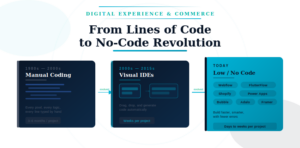
In the 1980s and through most of the 1990s, software development was an intensely manual craft. Developers worked in raw text editors or early Integrated Development Environments (IDEs) like Turbo Pascal and Borland C++. To build anything — even a simple form — you had to write the logic, the layout, the event handling, and the error management, all line by line. When Microsoft Visual Studio arrived in the late 1990s and gained dominance in the 2000s, it became the gold standard for professional development. Teams of developers would spend months building enterprise applications, meticulously crafting code in languages like C++, Java, Visual Basic, and later C# and ASP.NET. Every UI element — a button, a dropdown menu, a data table — had to be coded manually.What this era looked like in practice:
- A simple contact form on a website required writing HTML for structure, CSS for styling, JavaScript for validation, and server-side code for submission handling — all written manually.
- Website projects that would take 2 weeks today took 3 to 6 months back then.
- Debugging was painstaking — a misplaced semicolon or a missing bracket could crash an entire application.
- Only highly trained, specialized developers could participate in the process.
- Collaboration was difficult because code had to be version-controlled manually or through early, clunky tools.
- Mobile app development did not even exist as a discipline until the late 2000s.
The Visual Development Era: Drag, Drop, and Code
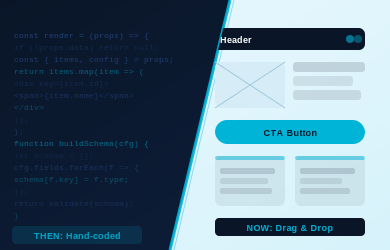
The late 1990s and 2000s introduced a significant shift: visual development tools. Instead of writing every line of UI code from scratch, developers could now drag and drop interface components onto a design canvas, and the tool would generate the underlying code automatically. Microsoft Visual Studio’s Windows Forms and WPF (Windows Presentation Foundation) were early examples of this approach. A developer could drag a button from a toolbox onto a form, and Visual Studio would write the corresponding code in the background. Macromedia Dreamweaver (later Adobe Dreamweaver) brought similar visual capabilities to web development — allowing designers to build web layouts visually while the HTML and CSS were generated automatically.Key tools and technologies from this era included:
- Adobe Dreamweaver — Visual HTML and CSS editor for web design with WYSIWYG capabilities.
- Microsoft Visual Studio Forms Designer — Drag-and-drop UI builder for Windows desktop applications.
- RAD (Rapid Application Development) tools like Delphi and PowerBuilder — which allowed faster app development through visual builders.
- Early CMS platforms like early versions of Joomla and Drupal — reducing the need to code entire website structures from scratch.
- Flash-based development tools — enabling rich interactive web experiences without writing browser-specific JavaScript.
- Eclipse IDE with visual plugins — extending visual development to Java-based enterprise systems.
The WordPress Revolution: Democratising the Web
In 2003, WordPress launched and gradually changed the web forever. By the early 2010s, it had evolved from a simple blogging tool into a fully-fledged Content Management System (CMS) that powered millions of websites. With themes, plugins, and visual page builders, businesses no longer needed to hire a team of developers to build a functional, attractive website. Page builders like Elementor, Divi, and WPBakery extended WordPress into a true visual development environment. A small business owner could now build and manage their own website without writing a single line of code. This was a pivotal moment – the beginning of the no-code mindset, even if the term had not yet been coined.Today’s Landscape: Low-Code and No-Code Platforms
We are now firmly in the era of low-code and no-code development. These platforms have moved far beyond simple website builders — they now power enterprise-grade web applications, mobile apps, e-commerce stores, internal business tools, and complex automated workflows. The distinction between the two is important:LOW-CODE
Minimal hand-coding required. Developers and technically-minded business users configure logic visually, but can extend functionality with custom code where needed. Ideal for complex business applications.
NO-CODE
Zero coding required. Business users, marketers, and entrepreneurs build functional websites, apps, and automations entirely through visual interfaces. Ideal for standard use cases and rapid deployment.
Website Development: No-Code & Low-Code Platforms
For website development and digital commerce, the market offers a rich selection of platforms that cater to different levels of complexity and scale:Webflow
A powerful no-code/low-code platform that gives designers pixel-perfect control over layouts using a visual canvas, while generating clean HTML, CSS, and JavaScript. Webflow is particularly strong for marketing websites, landing pages, and portfolio sites. It also includes a CMS for content-heavy sites and e-commerce capabilities for online stores.Wix
One of the most popular no-code website builders globally, Wix allows users to build professional websites through a drag-and-drop editor with hundreds of templates. Its ADI (Artificial Design Intelligence) feature can even generate a website automatically based on a few inputs. Wix also supports e-commerce, bookings, and business applications.Squarespace
Known for its design-first approach, Squarespace is a no-code platform favoured by creative professionals, restaurants, retailers, and service businesses. It offers high-quality templates and built-in tools for e-commerce, blogging, SEO, and email marketing.WordPress (with Elementor / Divi)
While WordPress itself requires some technical understanding to set up, modern page builders like Elementor and Divi have made it a near no-code experience. With thousands of plugins available, WordPress with a visual builder is arguably the most flexible and extensible website development approach in the market today.Shopify
The dominant platform for e-commerce website development. Shopify provides a no-code storefront builder combined with a powerful commerce engine — handling payments, inventory, shipping, and customer management. For more advanced customisation, developers can use Shopify’s Liquid templating language and APIs.Framer
A newer entrant that bridges design tools like Figma with live web publishing. Framer allows designers to build highly interactive, responsive websites visually without writing code, and is gaining rapid popularity for SaaS landing pages and product websites.Mobile App Development: Low-Code & No-Code Platforms
Mobile app development has historically been one of the most technically demanding disciplines — requiring expertise in Swift for iOS, Kotlin or Java for Android, and often separate codebases for each platform. Low-code and no-code platforms have transformed this landscape dramatically:FlutterFlow
Built on Google’s Flutter framework, FlutterFlow is a visual low-code builder that generates real Flutter code. It allows developers and non-developers alike to build cross-platform mobile apps (iOS and Android) using a visual drag-and-drop interface, while maintaining the ability to export and customise the underlying code. It includes Firebase integration for backend data management.Adalo
A true no-code mobile app platform that allows anyone to build native mobile apps without writing code. Users can create databases, design screens, set up navigation, and define logic through a visual interface. Adalo apps can be published directly to the Apple App Store and Google Play Store.Bubble
One of the most powerful no-code platforms available, Bubble enables the development of complex web applications and Progressive Web Apps (PWAs) without writing code. It supports custom databases, user authentication, API integrations, and sophisticated business logic — making it suitable for building full SaaS products.AppGyver (SAP Build Apps)
Now part of SAP, AppGyver is an enterprise-grade no-code platform for building mobile and web apps. It is particularly strong for businesses already in the SAP ecosystem and supports complex backend integrations.Microsoft Power Apps
Microsoft’s low-code application development platform, deeply integrated with Microsoft 365, Dynamics 365, and Azure. Power Apps allows organisations to build custom business apps that connect to their existing data — from SharePoint to SQL Server to Salesforce — with minimal coding. It is one of the most adopted low-code platforms in enterprise environments.OutSystems
An enterprise low-code platform designed for building mission-critical applications at scale. OutSystems supports complex application architectures, AI-assisted development, and deployment across web and mobile. It is widely used by large organisations in banking, healthcare, and government sectors.Mendix
Another leading enterprise low-code platform that enables collaborative app development between business teams and IT. Mendix includes AI-powered development features and is known for accelerating digital transformation projects.Glide
Glide is a no-code mobile app builder that creates apps directly from Google Sheets or Excel spreadsheets. It is particularly effective for internal business tools such as field service apps, inventory trackers, and employee directories — with zero development effort.Workflow Automation & Integration Platforms
Beyond websites and apps, low-code and no-code thinking has also transformed how businesses automate processes and connect their digital systems:Zapier
The most widely used no-code automation platform, Zapier connects thousands of apps and services through automated workflows called Zaps. It requires no coding and allows businesses to automate repetitive tasks — such as sending a Slack notification when a new lead is added to a CRM, or automatically creating an invoice when an order is placed.Make (formerly Integromat)
A more powerful alternative to Zapier, Make provides a visual workflow builder for complex multi-step automations and API integrations. It is favoured by businesses that need sophisticated logic, data transformation, and high-volume processing.Microsoft Power Automate
Deeply integrated with the Microsoft ecosystem, Power Automate allows businesses to automate workflows across Microsoft 365, Dynamics, and hundreds of third-party services. It supports both simple automations and complex AI-powered workflows.n8n
An open-source, self-hostable workflow automation platform that gives technical teams full control over their automation infrastructure. n8n supports complex logic and custom code where needed, while maintaining a visual interface for workflow design.Why the Shift Matters: Speed, Quality, and Business Impact
The evolution from manual coding to low-code and no-code is not just a technical trend — it has real, measurable business impact. Here is what this shift has delivered:Faster time to market
Projects that once took months can now be delivered in weeks or even days. For businesses operating in competitive, fast-moving markets — as is common in the UAE and wider GCC region — this agility is a critical advantage.Significantly reduced development costs
Fewer specialist developers are needed, and projects require less time. This makes digital products accessible to a much wider range of organisations, including SMEs and startups that previously could not afford bespoke app or website development.Lower error rates
Visual development environments reduce the risk of syntax errors and logical bugs that are common in manual coding. Platforms are tested and maintained by vendors, meaning common issues are handled at the platform level rather than being introduced in each project.Greater collaboration between business and IT
Business stakeholders can actively participate in building and configuring applications, reducing the miscommunication that often occurred when requirements had to be translated through layers of technical documentation into code.Easier maintenance and updates
Visual interfaces make it far simpler for non-technical team members to update content, adjust workflows, or add features without requiring a developer for every change.Scalability on demand
Cloud-native low-code and no-code platforms scale automatically, meaning a website or app built for 100 users can handle 100,000 users without the development team needing to rewrite infrastructure code.Does Low-Code Mean the End of Developers?
This is a question we hear often. The short answer is no. Low-code and no-code platforms have not made developers redundant — they have shifted the value of a developer’s expertise. Today, developers focus on what platforms cannot do: complex custom integrations, performance optimisation, security architecture, advanced AI/ML implementations, and building the custom extensions that take a standard platform to a bespoke solution. Think of it this way: no-code platforms handle the standard 80% of what most websites and apps need. Developers add the critical, differentiating 20% that makes a solution uniquely fit for purpose. The best development teams today use a combination approach — leveraging platforms for speed and reliability, then applying custom code where it genuinely adds value.How Innate Technologies Approaches Website and App Development
At Innate Technologies, we bring over 20 years of combined IT experience to every project. Our Digital Experience and Commerce practice is built on selecting the right tool for the right job — not defaulting to a single platform or technology stack regardless of the client’s needs. For some clients, a well-configured Webflow or Shopify solution is the most efficient and cost-effective path to a world-class digital presence. For others — particularly enterprises with complex integrations, custom business logic, or regulatory requirements — a low-code platform like Power Apps or OutSystems combined with bespoke development is the right approach. Our role is to bridge the gap between your business objectives and the technology that best delivers them — ensuring the solution is not only built quickly, but built to last, scale, and support your operations effectively.Conclusion
The journey from typing every line of code in Visual Studio to deploying a polished mobile app through a visual builder represents one of the most significant shifts in the history of technology. What once required a team of specialists and months of work can now be achieved by a smaller, more agile team — or in some cases, by business users themselves. For businesses across the UAE and the wider region, this evolution means that the barrier to building a strong digital presence has never been lower — and the speed at which you can respond to market opportunities has never been higher. Whether you are building a new website, launching a mobile app, or automating business workflows, there is now a platform designed to help you do it faster, better, and at lower cost than ever before. The question is no longer whether to embrace low-code and no-code development. The question is which approach, which platform, and which partner is right for your specific goals.Ready to build your next website or mobile app?
Innate Technologies helps businesses across Dubai and the UAE design, build, and scale their digital products. From no-code websites to enterprise mobile applications, we match your goals to the right technology. Get in touch with our team to start a conversation.