With over 16 million users across 175+ countries and growing at 120,000 new customers a year, Odoo has become the ERP of choice for businesses seeking flexibility, affordability, and real customisation. Here is everything you need to know about the platform — and why professional customisation is the key to unlocking its full potential.
What Is Odoo ERP?
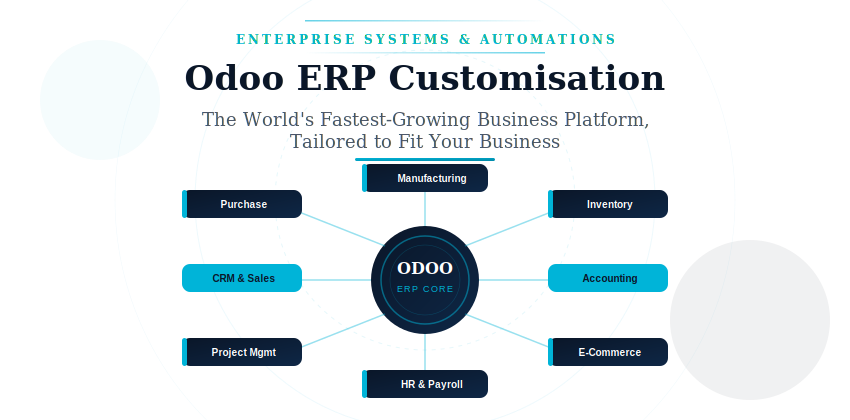
Odoo is an open-source, modular Enterprise Resource Planning (ERP) platform that consolidates all core business operations into a single, unified system. Built by Belgian company Odoo S.A. and launched in its current form in 2014, Odoo offers over 80 integrated business applications — covering everything from accounting, inventory, and sales to human resources, manufacturing, project management, and e-commerce.
Unlike traditional ERP systems that force businesses to buy a monolithic suite and pay for features they do not use, Odoo follows a modular approach. Companies start with the applications they need today and add more as they grow — paying only for what is actively in use. This makes it uniquely suitable for small and medium enterprises, as well as larger organisations looking for a cost-effective alternative to legacy ERP vendors like SAP or Oracle.
Odoo is available in two editions:
- Odoo Community — the free, open-source version maintained by a global community of developers, offering core ERP functionality with no licensing cost.
- Odoo Enterprise — the commercially licensed version, hosted on Odoo’s cloud or on-premise, which includes advanced features, mobile apps, dedicated support, and Odoo Studio (the built-in visual customisation tool).
How Popular Is Odoo? The Numbers Tell the Story
Odoo’s growth trajectory is remarkable. In a market dominated for decades by heavyweight vendors, Odoo has carved out a significant and rapidly expanding position — particularly among SMEs and mid-market businesses that need enterprise-grade functionality without enterprise-scale costs.
16M+
Users Worldwide
170K+
Enterprise Customers
€650M
Revenue in 2025
12-15%
SME ERP Market Share
To put these numbers in context: Odoo adds approximately 120,000 new customers every year and is growing at a compound annual rate of 20–25%. Its revenue grew 42% year-on-year in 2025, and the company is targeting €1 billion in revenue by 2027. In October 2025, Odoo surpassed 13,000 new client sign-ups in a single month alone.
Odoo’s strongest markets include Belgium, France, India, Spain, the UAE, and Saudi Arabia – making it particularly well-established in the GCC region where Innate Technologies operates. The UAE and wider Middle East have seen significant Odoo adoption, with numerous certified implementation partners serving businesses across manufacturing, trading, retail, construction, and professional services.
Three of the world’s four largest audit and consulting firms — commonly known as the Big Four – have adopted Odoo as part of their internal toolset, underscoring the platform’s credibility at the highest levels of enterprise operations.
What Odoo Covers: A Unified Suite of Business Applications
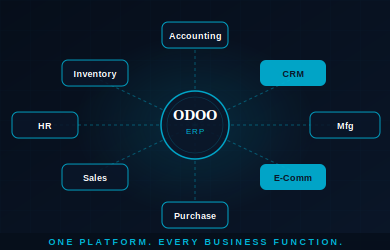
One of Odoo’s greatest strengths is the breadth and depth of its application suite. Rather than running separate, disconnected systems for different departments — an accounting package here, a CRM there, a separate HR tool elsewhere — Odoo unifies all business functions on a single platform with a shared database.
Sales & CRM
Lead management, quotations, sales orders, customer portal, pipeline tracking
Accounting & Finance
Invoicing, bank reconciliation, tax reporting, multi-currency, UAE VAT compliance
Inventory & Warehouse
Real-time stock tracking, multi-warehouse, lot/serial numbers, barcode scanning
Manufacturing (MRP)
Bills of materials, work orders, production planning, quality control, MRP scheduler
Human Resources
Employee records, payroll, leave management, recruitment, appraisals, expenses
Purchase & Procurement
RFQs, purchase orders, vendor management, automated reordering, landed costs
Project Management
Task tracking, Gantt charts, timesheets, kanban boards, client billing
E-Commerce & Website
Built-in website builder, online store, product pages, integrated with inventory
Point of Sale (POS)
Retail and restaurant POS, offline mode, loyalty programmes, real-time sync
Odoo Customisation: Adapting the Platform to Your Business
Out of the box, Odoo covers the standard requirements of most businesses. But every organisation has unique workflows, approval chains, reporting needs, and operational quirks that a generic ERP cannot address without modification. This is where Odoo customisation becomes critical — and where Odoo genuinely excels compared to its competitors.
Unlike SAP or Oracle, which typically require expensive proprietary consultants and months of complex configuration for even minor changes, Odoo's open architecture and modular design make customisation far more accessible, faster, and cost-effective. Here are the primary layers at which Odoo can be customised:
1. Odoo Studio — No-Code / Low-Code Customisation
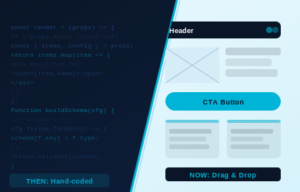
Odoo Studio is a built-in visual customisation tool included with the Odoo Enterprise edition. It allows business users and functional consultants to modify Odoo's interface, forms, and workflows without writing a single line of code.
With Odoo Studio, you can:
- Add, remove, or rearrange fields on any form, list, or kanban view
- Create entirely new fields — text, numbers, dates, selection lists, relational fields, computed fields
- Build custom reports and dashboards with drag-and-drop components
- Design automated workflows triggered by status changes or time conditions
- Create new Odoo applications from scratch with custom menus and navigation
- Modify approval flows and add multi-level validation to any business process
Odoo Studio is powerful for standard customisations, but it has limits. For complex business logic, cross-module integrations, or country-specific compliance requirements, custom development is required.
2. Custom Module Development
For requirements that go beyond what Odoo Studio can handle, Odoo's open-source architecture allows fully custom module development. Odoo modules are built using Python (for backend logic), XML (for views and data), and JavaScript/OWL (for frontend components). A skilled Odoo development team can build:
- Entirely new business modules that do not exist in the standard Odoo catalogue
- Industry-specific features such as UAE gratuity calculation, ZATCA e-invoicing compliance, BOQ (Bill of Quantities) for construction, or VIN management for automotive
- Custom approval workflows with multi-level sign-off, conditional logic, and email/SMS notifications
- Specialised reports in PDF or Excel format with custom layouts and branding
- Custom dashboards pulling real-time data from across all Odoo modules
- Mobile-optimised views and dedicated Odoo mobile applications for field teams
3. Third-Party Integrations
Modern businesses do not operate in isolation — they use a variety of tools and platforms that need to communicate with each other. Odoo's robust REST API and XML-RPC interface make it one of the most integrable ERP platforms available. Common integrations implemented by Odoo consultants include:
- Payment gateways: Stripe, PayTabs, Network International, PayFort (popular across UAE and GCC)
- E-commerce platforms: Shopify, WooCommerce, Magento — syncing products, orders, inventory, and customers bidirectionally
- Logistics and shipping: Aramex, DHL, FedEx, UPS — with real-time tracking and label printing
- Banking: UAE bank integrations for automated bank statement reconciliation
- Government compliance: ZATCA (Saudi Arabia), UAE VAT filing, FTA portal connectivity
- HR systems: Payroll integrations, biometric attendance devices, WPS (Wage Protection System) file generation
- Business intelligence: Power BI, Tableau, or custom reporting layers on top of Odoo data
- Communication tools: WhatsApp Business API for automated customer notifications, SMS gateways
Customisation in Practice: A Real-World Example
Use Case: Manufacturing Company — Custom Work Order Tracking with Barcode Integration
To illustrate what Odoo customisation looks like in practice, consider a mid-sized manufacturing company in the UAE producing furniture across multiple production stages: Wood Cutting, Assembly, Coloring, and Packing.
Out of the box, Odoo's Manufacturing module manages work orders and tracks production progress — but the standard interface is designed to process one item at a time. For a factory processing hundreds of units daily across parallel production lines, this creates operational friction.
THE CHALLENGE
Workers manually updated spreadsheets for each production stage. No real-time visibility on how many units had passed through each work centre. Returns and quality rejections were tracked in a separate system. Inventory errors were causing costly delays and customer complaints.
THE SOLUTION
Innate Technologies implemented a custom Odoo module extending the Manufacturing module. Workers now scan product barcodes as each unit moves between work centres. The system automatically updates production order status in real time and triggers inventory adjustments. A custom dashboard gives the production manager live visibility of all work in progress.
THE RESULT
Inventory errors reduced by 32%. Production returns processed 45% faster. Real-time production visibility eliminated the need for daily manual reporting. Management dashboards now show live output per work centre, enabling faster decisions and resource reallocation during peak periods.
What makes this customisation significant is not just the technical outcome, but the business impact. The production team no longer relies on manual data entry. The ERP becomes the single source of truth — automatically connected to inventory, accounting, and quality management — rather than an administrative burden layered on top of real operations.
Industries Where Odoo ERP Delivers the Greatest Impact
While Odoo can be applied across virtually any industry, there are several verticals where the platform has particularly strong adoption and proven results — especially across the UAE and GCC markets:
Manufacturing & Industrial
Odoo's MRP, inventory, and quality modules make it a natural fit for manufacturers. Features like Bills of Materials (BOM), work order routing, machine work centres, barcode scanning on the shop floor, and automated procurement based on production demand give manufacturers full visibility from raw material to finished product. UAE manufacturers increasingly rely on Odoo to meet compliance requirements around batch tracking and quality audits.
Retail & E-Commerce
For retail businesses, Odoo unifies point-of-sale operations, inventory management, and online storefronts in one system. Price lists, loyalty programmes, multi-location stock management, and real-time sync between physical stores and online channels eliminate the operational silos that plague most retailers. The integrated e-commerce module also allows businesses to launch and manage an online store without a separate platform.
Construction & Real Estate
The construction sector in the UAE has been a strong adopter of Odoo, particularly for project cost tracking, sub-contractor management, and progress billing. Custom modules handle BOQ (Bill of Quantities) management, material requisitions by project phase, and certified invoicing tied to project milestones. Real estate firms use Odoo to manage property listings, lease contracts, maintenance requests, and owner portal access.
Healthcare & Clinics
Private clinics and healthcare providers across the UAE use Odoo to manage patient appointments, medical records, insurance billing, pharmacy inventory, and payroll — all within a single system. Custom Odoo modules add patient intake forms, clinical notes, and integration with diagnostic lab systems. Several UAE healthcare groups have reported reducing administrative overhead by over 30% after implementing customised Odoo systems.
Logistics & Distribution
Distribution companies and freight forwarders use Odoo to manage purchase orders, supplier relationships, landed costs, multi-warehouse operations, and delivery scheduling. Custom integrations connect Odoo with carrier APIs for real-time tracking, and with customer portals for self-service shipment status visibility. The UAE's position as a regional logistics hub makes Odoo a compelling choice for businesses managing complex supply chains.
Professional Services & Consulting
Law firms, accounting practices, IT consultancies, and engineering firms use Odoo to manage project timelines, resource allocation, timesheets, client billing, and contract management. The platform's project management and CRM modules combine to give services businesses a clear view of every client engagement from lead to invoice - with profitability tracking at the project level.
Why Professional Odoo Customisation Matters
Odoo's flexibility is its greatest asset — and its greatest risk. The same openness that makes deep customisation possible also means that poorly executed implementations can create systems that are difficult to maintain, prone to breaking on upgrades, or simply not aligned with how a business actually operates.
Here is why working with experienced Odoo professionals is critical:
How Innate Technologies Approaches Odoo ERP Customisation
At Innate Technologies, Odoo ERP customisation is a core part of our Enterprise Systems and Automations practice. Our team brings over 20 years of combined IT and ERP experience to every engagement — meaning we understand not just the technical architecture of Odoo, but the operational realities of the businesses we serve across the UAE and wider GCC region.
Our approach to Odoo customisation follows a structured methodology:
- Business Process Review: We begin by understanding how your business actually works — not how you think it should work in an ERP. This involves workshops with key stakeholders across departments.
- Gap Analysis: We map your requirements against standard Odoo capabilities, identifying what configuration handles, what Odoo Studio can address, and what requires custom development.
- Phased Implementation: We deploy in structured phases, starting with foundational modules and expanding systematically — avoiding the big-bang approach that causes most ERP project failures.
- Custom Development: Where needed, our developers build upgrade-safe custom modules in Python, XML, and OWL, following Odoo's official development standards.
- Integration Architecture: We design and implement integrations with your existing tools — payment gateways, government portals, e-commerce platforms, and third-party APIs.
- Training and Handover: We train your team thoroughly and provide complete documentation, ensuring your business is self-sufficient after go-live.
- Post-Go-Live Support: We remain available for ongoing support, enhancements, and version upgrades through structured maintenance agreements.
Conclusion
Odoo has earned its position as one of the world's fastest-growing ERP platforms by doing something its competitors have historically failed to do: making enterprise-grade business management genuinely accessible, affordable, and adaptable. With 16 million users, a rapidly growing presence across the UAE and GCC, and the flexibility to be customised for virtually any industry or workflow, Odoo is no longer the challenger - it is increasingly the benchmark.
But the power of Odoo is only fully realised through well-executed customisation. The difference between a generic Odoo installation and a properly customised one is the difference between software that fits around your business and software that your team is forced to fit around. Getting this right requires experience, methodology, and deep familiarity with both the platform and the industries it serves.
If your business is exploring Odoo ERP for the first time, considering a migration from an existing system, or looking to extend and improve a current Odoo implementation, the right partner makes all the difference.
Talk to an Odoo Expert at Innate Technologies
Innate Technologies offers Odoo ERP consultation, customisation, integration, and support services for businesses across Dubai and the UAE. Whether you are starting your ERP journey or looking to get more from an existing Odoo system, our team is ready to help. Get in touch with our team to start a conversation.